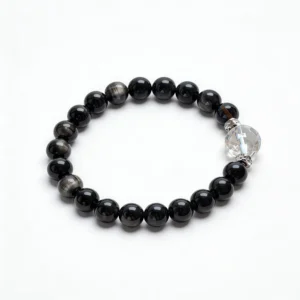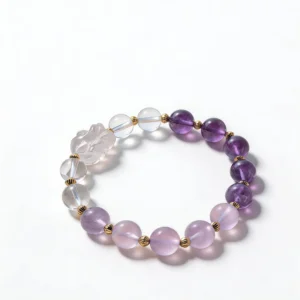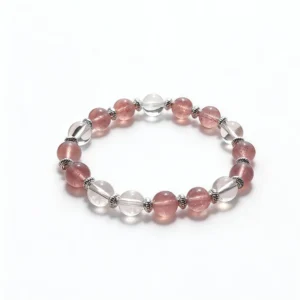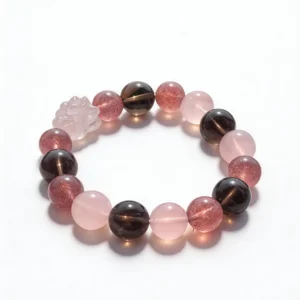


An obsidian and tiger eye bracelet works as a dark neutral with visible texture. Black, silver-gray, and brown tones can connect shoes, belts, watches, and outerwear without requiring an all-black outfit. The key is to keep one clear focal point, account for the bead size, and judge sheen in ordinary light.
Use black and brown as a deliberate pair
Black obsidian tones and brown or golden tiger eye tones naturally bridge cool and warm wardrobe elements. Try them with charcoal and camel, navy and tan, olive and black, or blue denim and brown leather. Repeating one black detail and one brown detail elsewhere in the outfit usually creates enough connection.
Choose contrast according to the setting
Against a black sleeve, the bracelet may read through reflected light and brown bands rather than outline. Against white, gray, or pale blue, its silhouette becomes stronger. For a quiet work look, use a darker sleeve. For more visual emphasis, place the bracelet against a lighter cuff or bare wrist.
Read sheen in moving light
Silver sheen and chatoyant bands can appear differently as the wrist turns. A single front-facing photograph cannot represent every angle. Look for multiple views, side lighting, and close detail; then separate what the images show from assumptions about material identity, origin, treatment, rarity, or grade.
Know what tiger eye describes
A GIA museum reference on tiger’s-eye quartz identifies tiger eye within the quartz family and shows why its banded optical appearance matters. Use that source for category context. The seller’s listing and any item-specific documentation remain the source for what is actually included in a bracelet.
Keep obsidian and tiger eye distinct
Obsidian and tiger eye are not interchangeable names. GIA’s research note on bubble obsidian from Armenia discusses obsidian as volcanic glass and illustrates that internal features require gemological interpretation. A shopper should not use appearance alone to infer a particular source or unusual variety.
Let the 10mm profile lead
The Silver Obsidian Tiger Eye Bracelet is a current example with a noticeable bead scale. Wear it alone for the cleanest result, next to a watch with a small gap, or with one slimmer strand. Several large dark bracelets can compete with each other and add more movement than expected.
Measure for the way it will be worn
Follow Size Help, then consider the watch, sleeve cuff, and stacking plan. A bracelet that fits well alone may feel crowded when placed beside a watch. A very loose fit can rotate more, changing which sheen or banded areas face outward.
Use simple styling formulas
- Pair a white Oxford shirt and dark denim with the bracelet worn alone.
- Combine an olive overshirt, black tee, and brown footwear to repeat both color families.
- Wear charcoal knitwear with a steel watch and leave the bracelet as the warm accent.
- For evening, use a black base and one restrained gold or brass detail.
Inspect construction before repeat wear
Check polish, chips, drill-hole rims, spacers, and the visible condition of elastic or cord. Ask how the piece is assembled when the closure or knot is not shown. QZZEN’s Authenticity Promise provides the route for material-description and documentation questions without implying that every item has a laboratory report.
Protect surfaces and stringing
Remove the bracelet for water, exercise, sleep, and household chemicals. Use a soft damp cloth when appropriate, dry the stringing fully, and store the piece separately. Avoid ultrasonic or steam cleaning unless every material and construction component has been confirmed suitable.
Review the transaction while uncertainty remains
Color, sheen, and fit can differ between a screen and the wrist. Read the Returns policy before ordering, then inspect the delivered bracelet in indirect daylight before regular wear.
Bottom line
Style an obsidian and tiger eye bracelet as a textured dark neutral: repeat black and brown once, let the 10mm scale be the focal point, and keep the rest of the wrist simple. Choose it for visible design and practical wear, not for promised protective, medical, emotional, or financial outcomes.