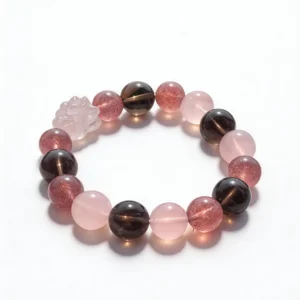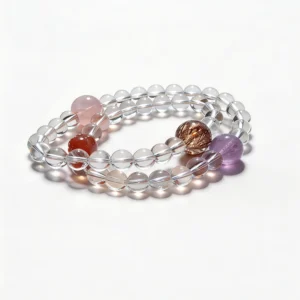


A bracelet shown in a popular short video should be checked against the actual product listing before purchase. Pause on clear frames, note the bead scale and construction, then compare those observations with the seller’s material name, dimensions, photographs, and variant details. A clip can introduce a design, but it cannot establish the identity or quality of the material by itself.
Separate the Source Clip From the Product Listing
Start by identifying where the video came from. A creator’s styling clip, a seller’s demonstration, and a reposted compilation provide different levels of product information. Record the account, caption, posting date, and any visible product name or link. If the clip has been reposted, find the original source when possible before assuming that a tagged listing shows the same bracelet.
Open the product page separately and compare the title, selected variant, current photographs, and specifications. A familiar color sequence does not prove that two bracelets share the same material or construction. Similar designs can use different bead diameters, hardware, cord, or processed materials.
Capture Frames That Show Useful Evidence
Choose frames that show the whole bracelet, several neighboring beads, the closure or knot area, and any charm attachment. A single close-up may be attractive but can hide the overall sequence. A distant wrist shot may show styling while revealing little about drill holes, polish, or individual variation.
Use screenshots only as comparison notes. Video compression, motion blur, color grading, and platform sharpening can change edge detail and surface appearance. If the clip includes several lighting conditions, compare the same bead across them rather than using unrelated beads as proof of a color change.
Account for Filters and Edited Color
Short-form video often raises contrast, saturation, and brightness. Skin tone, white fabric, metal color, and the surrounding surface can act as references. If all of them shift toward the same tint, the bracelet color may also be affected by the edit. A screen recording can introduce another layer of compression or color change.
Look for seller photographs against a neutral background and, when available, ordinary indoor light. Compare broad characteristics such as pale versus dark, opaque versus translucent, and uniform versus visibly varied. Do not expect a phone screen to reproduce an exact shade.
Compare Bead Scale With a Known Reference
A viral clip may use a close camera angle that makes beads appear larger. Use visible references such as a watch case, clasp, finger width, or ruler only as rough context, then rely on the stated measurement in the listing. A bracelet made with 6 mm beads has a different visual footprint from one made with 10 mm beads even when both use a similar palette.
Check whether the selected option changes bead diameter, strand length, or charm size. Product galleries sometimes combine several variants in one set of images. The specification and chosen option should identify which image most closely represents the item being ordered.
Inspect Variation Across the Entire Strand
Review multiple beads for hue, clouding, banding, translucency, mineral traces, and internal features. Variation can be consistent with many natural materials, but it is not proof of origin. Uniformity can result from sorting or from a manufactured material, so it is also not a complete test.
Compare the sequence in the clip with the listing photographs. Note repeated markings, the location of a focal bead, and the arrangement near a charm or spacer. Because individual stone beads can differ, the seller should explain whether the photographed piece is the exact item or a representative example.
Read Material and Processing Terms Carefully
Material wording should be as specific as the available evidence permits. Quartz, agate, glass, resin, composite material, and synthetic material are not equivalent descriptions. Natural origin does not automatically mean unprocessed, rare, flawless, or independently tested.
Look for direct disclosure of dyeing, coating, heat processing, reconstruction, or other modification when applicable. A trade name may be useful for shopping, but it should not replace a plain material description. When testing or documentation is not stated, regard the listing name as seller-provided information rather than laboratory verification.
Check Drill Holes, Cord, Clasps, and Charms
Construction details often disappear during fast cuts. Pause near the underside of the wrist or wherever the strand closes. On stretch bracelets, look for even spacing, intact cord, and a finished knot area. On clasped designs, inspect jump rings, crimps, connectors, and the point where the strand meets the hardware.
Enlarge clear listing photographs around drill openings and adjacent beads. Rough rims, large chips, exposed cord, or a charm that rubs directly against a bead may affect appearance during repeated wear. Metal color alone does not establish whether a component is plated, filled, sterling silver, stainless steel, or another alloy.
Reconcile Every Claim With the Selected Variant
Compare the video caption, product title, short description, full description, specifications, and option selector. The material name, bead size, strand type, hardware, and included components should agree. If a creator uses a custom stack, verify that each visible strand is actually included rather than assuming the listing sells the complete arrangement.
Price and popularity are not material tests. A high view count does not validate origin, and a low price does not identify composition on its own. Useful seller evidence consists of consistent specifications, clear photographs, direct processing disclosure, and a way to ask about details that are not shown.
Use a Frame-to-Listing Comparison Table
- Whole design: compare bead sequence, focal elements, and the number of strands.
- Scale: record the listed bead diameter and finished bracelet size.
- Material: note the exact seller wording and any processing disclosure.
- Construction: compare cord, clasp, spacers, jump rings, and charm attachments.
- Color: review neutral-background photographs instead of relying on one edited frame.
- Variant: confirm that the selected option matches the images and specifications.
Use the same fields for every candidate. A fixed comparison makes it easier to identify missing information and prevents one polished clip from receiving more weight than a detailed listing.
Inspect the Bracelet When It Arrives
- Save the product page and selected-variant details with the order record.
- Compare the complete strand with the listing photographs under ordinary light.
- Measure bead diameter and wrist fit against the published dimensions.
- Inspect drill holes, cord, closures, spacers, and attachments before extended wear.
- Photograph any material difference or construction issue while packaging is available.
Allow for any natural variation the seller disclosed, but document differences that change the product type, size, included components, or usability. Current support and policy terms should be checked on the relevant site pages rather than inferred from an older video.
Compare Real Listings With the Same Method
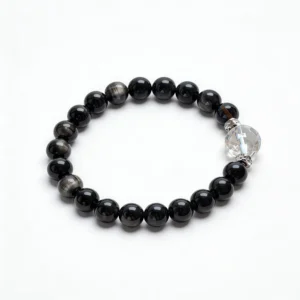
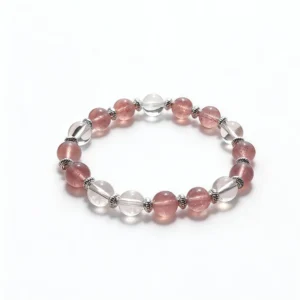
Apply the checklist across the QZZEN crystal bracelet collection or the wider QZZEN shop. For a direct construction comparison, review the photographs and specifications for the 8 mm obsidian and clear quartz rune bracelet and the 8 mm clear and strawberry quartz bracelet.
Compare what each page states rather than assuming that a material, charm, or finish behaves the same across products. For sizing, measure the wrist first and use the QZZEN size guide before selecting a finished bracelet size.
Create With QZZEN
Test a Bracelet Layout Beyond the Short Video
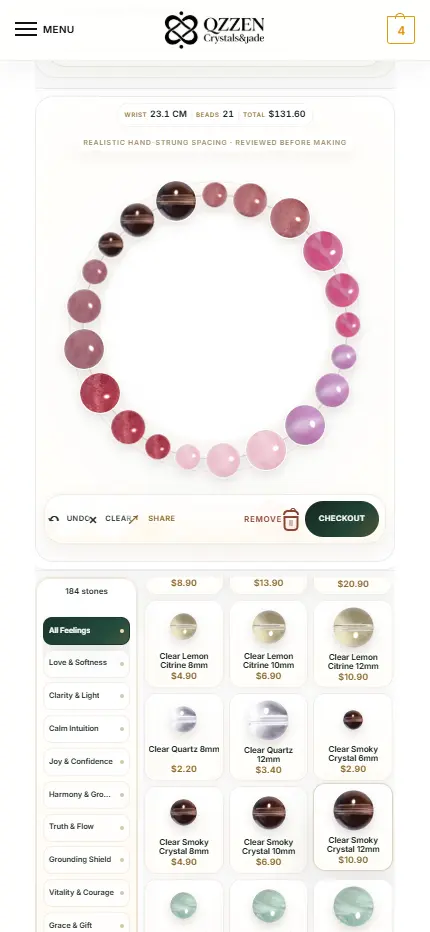
Use QZZEN Create to examine a complete circular layout, compare bead scale, and review the sequence without fast cuts or camera filters. Keep the same material, measurement, construction, and variant checklist beside the preview.