The jade market is flooded with imitations. From dyed quartzite to resin-filled “Grade B” jade to outright glass fakes, knowing how to identify real jade is essential before you spend your money. This practical guide gives you the tools to authenticate jade with confidence — no gemology degree required.
Understanding Jade Grades: A, B, and C
Before testing for authenticity, understand that “jade” exists on a quality spectrum:
- Grade A Jade — 100% natural, untreated. Only cleaned and polished. This is genuine jade in its purest form.
- Grade B Jade — Natural jade that has been bleached with acid and injected with resin to improve appearance. Looks better initially but degrades over time.
- Grade C Jade — Bleached, resin-filled, AND artificially dyed. The color is entirely fake.
Only Grade A jade has the energetic properties, durability, and investment value that make jade worth buying. Always ask for certification.
5 Practical Tests to Identify Real Jade
Test 1: The Temperature Test
Real jade feels noticeably cool to the touch and warms slowly in your hand. Glass and plastic warm up quickly. This is one of the most reliable quick tests — hold the piece for 30 seconds and notice how it responds.
Test 2: The Hardness Test
Jade (both nephrite and jadeite) is harder than a steel knife. Try to scratch an inconspicuous area with a knife blade — real jade won’t scratch. Soft imitations like serpentine or soapstone will show marks easily.
Test 3: The Sound Test
Tap two pieces of jade together or tap jade against a hard surface. Real jade produces a clear, musical ring — similar to a bell. Plastic and glass produce a dull thud. This test works especially well for bangles.
Test 4: The Visual Inspection
Examine the jade under good light:
- Natural color variation — real jade has subtle, organic color distribution, not uniform patches
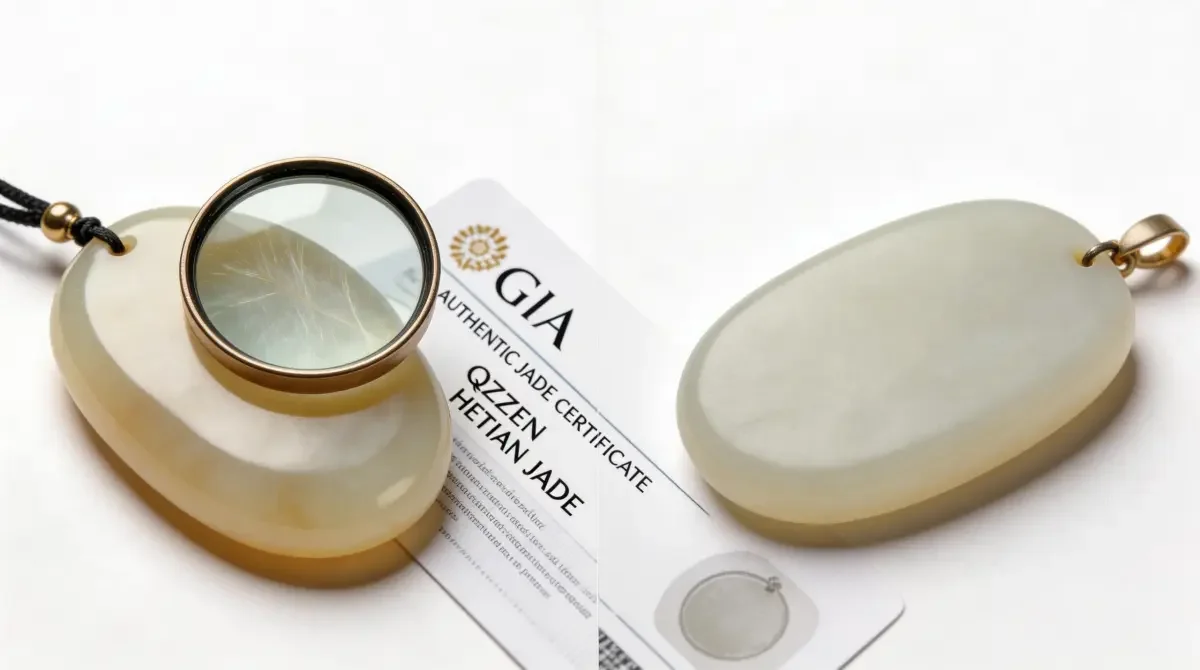
- Fibrous texture — nephrite jade shows a fibrous, interlocking crystal structure under magnification
- Natural inclusions — small natural imperfections are a good sign; perfect uniformity is suspicious
- Waxy luster — real jade has a characteristic waxy sheen, not a glassy shine
Test 5: The UV Light Test
Under ultraviolet light, Grade B jade (resin-filled) often shows a blue-white fluorescence from the resin. Natural Grade A jade typically shows little to no fluorescence. This test requires a UV lamp but is highly reliable.
Red Flags When Buying Jade
- Price that seems too good to be true (quality jade has real value)
- No certificate of authenticity or sourcing information
- Uniformly perfect color with no natural variation
- Seller unable to answer questions about jade grade or origin
- Plastic-looking surface or lightweight feel
The Safest Way to Buy Real Jade
The most reliable protection is buying from a reputable seller who provides:
- Written certification of natural, untreated (Grade A) jade
- Clear information about jade origin (Xinjiang, Myanmar, etc.)
- A return policy that allows you to have the piece independently verified
At Qzzen, every piece in our jade collection is certified natural Xinjiang jade. We stand behind every sale with a 30-day return guarantee and free shipping on orders over $100. Buy with confidence.
Explore Our Jade Collection


Free shipping on orders over $100. All products include 30-day hassle-free returns.