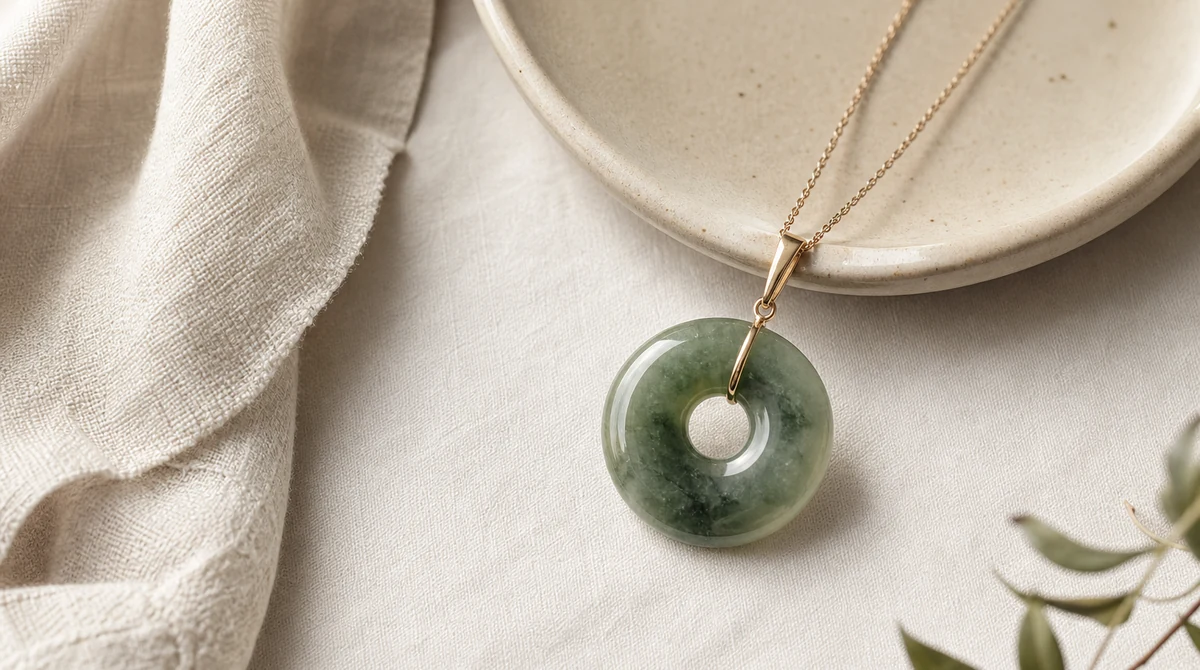
Jade is often connected with good fortune because generations of makers, families, and wearers have used the material in objects associated with value, virtue, continuity, status, remembrance, and protection. That history gives jade a rich symbolic vocabulary. It does not prove that a piece attracts money, changes probability, prevents harm, or guarantees a future outcome.
Treat good fortune as cultural language
Words such as luck, prosperity, blessing, and protection can describe what a giver or wearer hopes to honor. Their meaning changes across regions, families, periods, and occasions. Ask what the association means to the intended wearer instead of presenting one interpretation as universal. A piece can mark a hopeful beginning without being sold as a mechanism that causes success.
Understand why history matters
GIA’s overview of jade history and lore describes the material’s long importance and the beliefs that have surrounded it. Historical use helps explain why jade remains common in milestone gifts and family stories. Evidence that people valued a material or motif in the past is evidence of cultural context, not scientific evidence for supernatural effects.
Separate material from meaning
The gem name jade covers jadeite and nephrite, according to the GIA jade description. A fortune association cannot identify the material, establish treatment status, prove geographic origin, or determine quality. Read the exact product statement, dimensions, photographs, and documentation. QZZEN’s Authenticity Promise provides a route for questions about stated material facts.
Read motifs in context
Fish, gourds, coins, bats, ruyi forms, circles, leaves, and other designs may carry associations in particular visual traditions. The same motif can also be chosen simply for its shape or workmanship. When the history is not documented, use careful phrasing such as “often associated with” or “chosen here to represent.” Do not invent an ancient date, region, ritual, or fixed translation for a product listing.
Choose a gift for the recipient
A good-fortune gift may suit a graduation, new job, wedding, move, business opening, or new year. Match the scale, jewelry format, color, and hardware to the person’s actual taste. Include a short note explaining the giver’s intention in plain language. Avoid assigning a spiritual belief, financial expectation, fertility narrative, or health story that the recipient did not choose.
Write a bounded gift message
- “For a hopeful start in your new role.”
- “A reminder of the family support around you.”
- “Chosen to mark this new chapter.”
- “Wishing you steadiness and good opportunities ahead.”
These messages express care and hope without claiming the jewelry will produce an outcome. Save any material documentation separately from the personal card so sentiment and product evidence remain distinct.
Evaluate the jewelry itself
Inspect polish, carving edges, openings, bead holes, clasps, bails, elastic, or cord. Compare dimensions and determine whether photos show the exact item or representative inventory. Browse The Jade Collection for current forms, while treating every individual listing as the source for that piece’s claims.
Plan timing and returns
For a dated occasion, review current Shipping information before ordering and allow time for inspection. Read the Returns policy if the recipient may need another format or size. A symbolic gift still needs ordinary transaction protections.
Bottom line
Jade symbolizes good fortune through accumulated cultural use and personal interpretation, not because a product can guarantee luck. Honor the context, explain the intended meaning carefully, verify the material and workmanship separately, and choose a form the recipient will genuinely wear or keep.