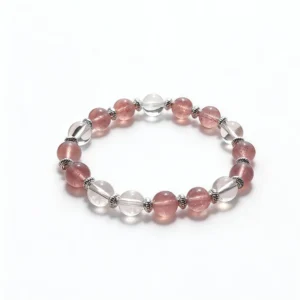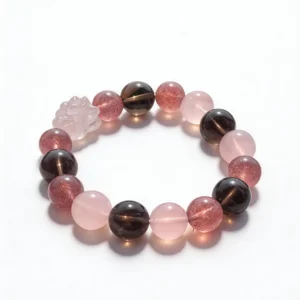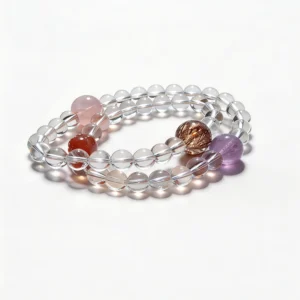


A seven-color crystal bracelet is easiest to design when color order, contrast, bead diameter, and wrist fit are planned together. The arrangement can carry wearer-assigned symbolism, but color does not establish a medical effect or a measurable property beyond appearance.
Define the Seven-Color Layout
Decide whether the design will use exactly seven feature beads, seven repeated color groups, or a continuous sequence around the wrist. These structures look different even when they use the same materials.
A seven-bead feature section creates one clear viewing side. Repeated groups distribute color around the strand. A continuous sequence uses gradual transitions and may require several shades within each color family.
Choose a Sequence Before Choosing Stones
Write the intended order before shopping. A spectrum-like sequence can move through red, orange, yellow, green, blue, violet, and a selected neutral or transitional hue. Another design may use seven colors connected to a personal reference, organization, event, or artwork.
There is no universal mineral list required for a seven-color bracelet. Select the order for visual or personal reasons and describe any symbolism as an interpretation rather than a property of the beads.
Compare Hue, Value, and Saturation
Hue is the color family, value describes how light or dark it appears, and saturation describes its visual intensity. A strand can include seven different hues and still look uneven if one bead is much darker, brighter, or more opaque than the others.
- Use similar values for a smooth, continuous sequence.
- Alternate light and dark beads for a more graphic pattern.
- Repeat one neutral spacer to connect unrelated hues.
- Reserve the most saturated bead for an intentional center point.
- Check translucent beads against skin, fabric, and a neutral background.
Select Materials by Visible Appearance
More than one material can represent each color position. Compare actual photographs for hue, translucency, pattern, inclusions, surface finish, and variation. Names alone are unreliable visual guides because specimens within one mineral family may differ substantially.
Ask for the stated mineral or material name and known processing. Dyed, coated, composite, glass, and laboratory-created beads should be described accurately. Appearance by itself does not prove identity, origin, or lack of processing.
Plan Bead Diameter and Strand Length
Larger beads occupy more circumference and leave less room for the same number of elements. They also make differences in diameter more visible. Confirm actual bead measurements rather than estimating from enlarged product photos.
- Measure the wrist using the method in the selected size guide.
- Choose a primary bead diameter in millimeters.
- Estimate how many beads and spacers fit the intended circumference.
- Place the seven-color section where it will remain readable on the wrist.
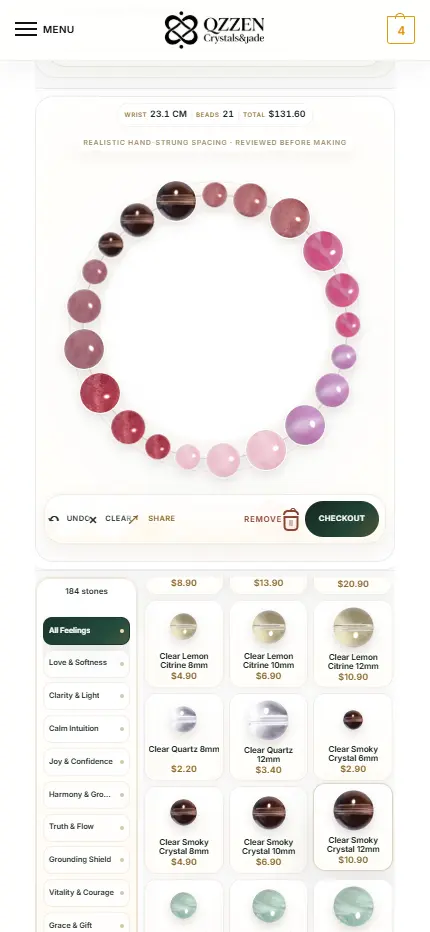
- Review the complete circular layout before finalizing the strand.
Use Symmetry Deliberately
A centered layout can place one color in the middle with three positions on each side. A mirrored design can repeat colors outward from a center bead. An asymmetric design can place all seven hues in a single directional run.
Symmetry is a design choice, not a quality requirement. What matters is that the sequence remains intentional after accounting for the clasp, knot cover, charm, or hidden join.
Decide Whether to Add Spacers
Metal, glass, or neutral stone spacers can separate adjacent hues, but every spacer changes circumference and visual rhythm. Thin repeated spacers create clear divisions. Larger decorative components compete more strongly with the seven-color sequence.
Check that spacer edges are smooth and that their holes suit the strand material. Hard or sharp components should not abrade cord or press against vulnerable bead edges.
Review the Layout Under Ordinary Light
Warm bulbs, cool LEDs, daylight, camera processing, and screen settings can shift apparent color. Review the sequence under at least two ordinary light sources and rotate the bracelet so reflections do not hide translucent or polished details.
Photograph the complete strand against a neutral background. A circular view reveals repeated colors, abrupt transitions, misplaced spacers, and areas that look crowded more clearly than a straight row of loose beads.
Check Seller Information
A useful listing states the material, bead diameter, strand construction, expected variation, known processing, and whether photographs show the exact item or a representative example. If a specific sequence matters, confirm it in writing rather than assuming every bracelet follows the same order.
- Verify the seven stated materials or color positions.
- Check the inner fit or sizing method.
- Confirm cord, clasp, spacer, and charm details.
- Ask how substitutions or natural variation are handled.
- Keep unsupported origin or certification fields unassigned.
Care for Mixed-Material Bracelets
Use care directions suitable for every component in the strand. Water, chemicals, heat, strong light, ultrasonic cleaning, and abrasive contact can affect materials differently. The most sensitive bead, coating, metal, adhesive, or stringing component should set the practical limit.
Store the bracelet separately, inspect the strand for wear, and stop using it if a cord frays, a fitting loosens, or a bead develops a sharp damaged edge.
Preview a Seven-Color Bracelet
Browse the QZZEN crystal bracelet collection, use the bracelet size guide, or open QZZEN Create to compare seven-color sequences, bead diameter, and spacing before checkout.
Create With QZZEN
Test a Seven-Color Sequence in a Full Circle
Compare color order, bead diameter, and spacers in a finished bracelet layout before you order.