
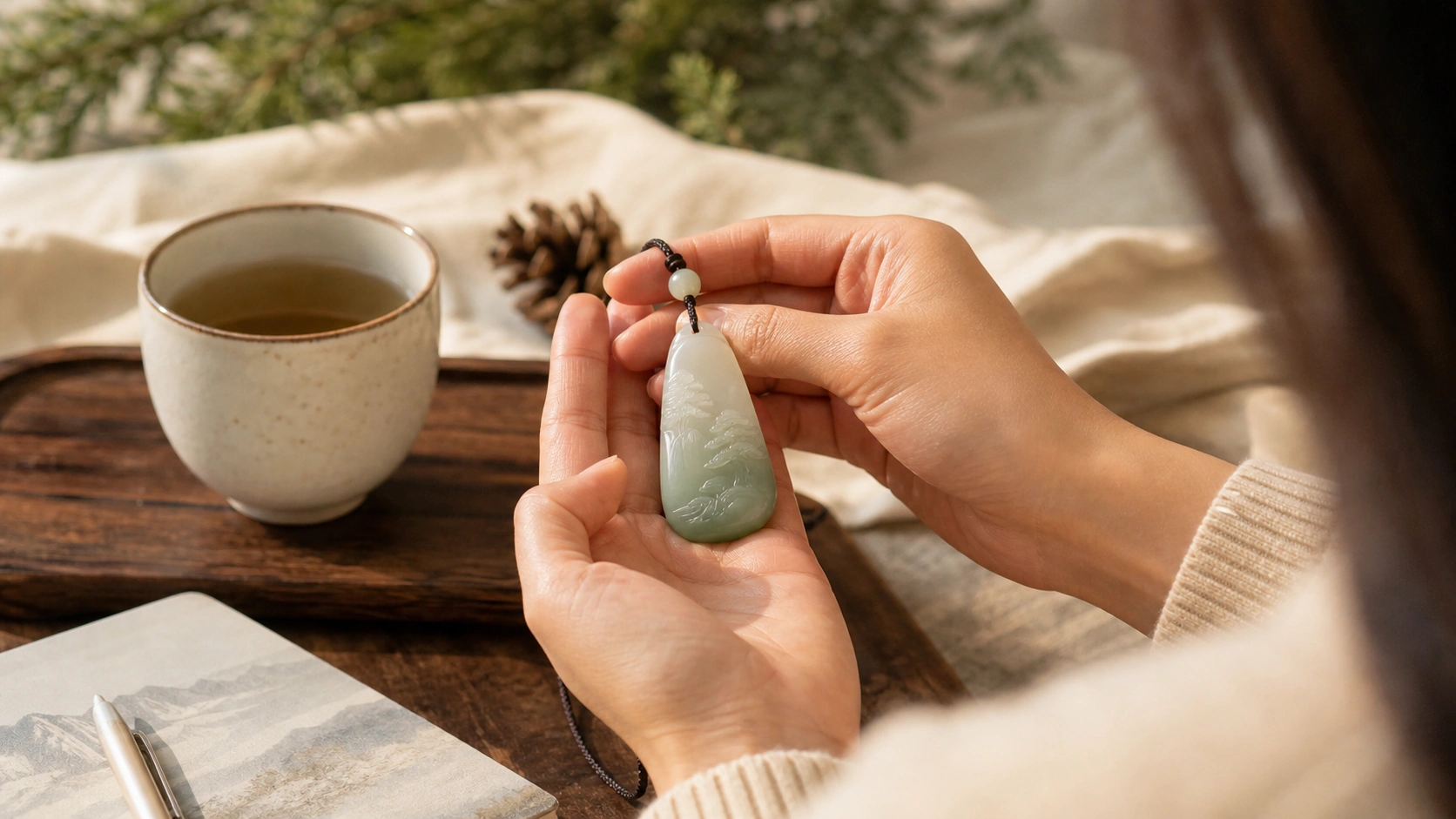
A landscape pendant should be evaluated as a three-dimensional carved object, not only as a front-facing picture. Review the scene from both faces, trace its edges and openings, check the polish under changing light, and confirm the measurements and suspension hardware. Material identity, treatment disclosure, workmanship, and personal taste are separate questions, so assess each one directly.
Inspect the carving from every side
Begin with front, back, profile, and angled photographs. On the main face, look for readable depth between foreground and background elements. Then check whether the reverse is intentionally finished rather than ignored. A natural color patch or texture can be part of the design; it should not automatically be called a defect or proof of quality. Ask for another view when a shadow hides an important section.
Trace edges, openings, and thin bridges
Follow the outer silhouette and every pierced opening. Look for abrupt chips, unfinished recesses, or narrow bridges that may be vulnerable during wear. Drill holes and connector channels should appear clean enough not to abrade a cord. Fine detail is valuable only when it remains coherent at the pendant’s actual size and the carving can be handled without catching on ordinary clothing.
Evaluate polish under useful light
A polished surface should reflect light consistently across comparable areas while preserving intentional carved texture. Examine highlights for flat spots, obvious scratches, residue in recesses, or cloudy patches that the listing does not explain. Do not confuse a bright studio reflection with transparency. Ask whether images show the exact item or a representative piece when natural variation could affect the received pendant.
Read the material disclosure precisely
GIA’s jade description distinguishes jadeite from nephrite. Check the exact material wording on the Hetian Jade Landscape Pendant listing, along with any treatment disclosure and documentation offered. The terms Hetian, natural, hand-carved, or certified should not be expanded beyond what the seller specifically supports for the piece.
Verify dimensions and visual scale
Record height, width, and thickness, and confirm whether height includes the bail. Compare those numbers with a pendant you can hold rather than judging a close-up image. Landscape scenes often contain many small elements; decide whether the design remains legible at normal viewing distance. Weight, if listed, also helps indicate whether the pendant will feel light, moderate, or substantial on the intended suspension.
Check the bail, cord, or chain
Identify what is actually included. Inspect the bail opening, connector direction, cord or chain length, clasp, and attachment points. The pendant should hang facing forward without twisting excessively, and the suspension should be appropriate for its stated size and weight. Use the jade pendant selection guide to compare neckline placement and everyday-wear considerations.
Separate design preference from quality
A calm mountain-and-water composition, strong color contrast, or an asymmetrical natural pattern may appeal to one buyer and not another. Those are aesthetic preferences. Workmanship questions are more concrete: whether edges are finished, recesses are clean, the polish is coherent, vulnerable sections are disclosed, and the hardware functions as described. Keeping the two categories separate makes comparisons more useful.
Inspect the pendant on arrival
- Photograph the unopened package and the item in neutral light.
- Compare the pendant with listing images, dimensions, and included-components description.
- Check both faces, edges, openings, bail, cord or chain, and clasp.
- Keep tags, packaging, receipts, and supplied documentation together.
- If something materially differs, stop wearing it and consult the current Returns policy promptly.
Use conservative care
GIA’s jade care guidance recommends warm soapy water and notes that heat can affect treated material. Avoid ultrasonic or steam cleaning unless the material, treatments, and assembly are known to support it. A soft cloth, careful handling, and separate storage also protect carved high points and suspension hardware.
Bottom line
A useful landscape-pendant quality check follows the whole object: scene, reverse, profile, openings, polish, dimensions, disclosure, and suspension. Compare the live listing with what arrives and document any meaningful difference before wear. QZZEN’s Authenticity Promise provides a route for material and documentation questions that remain after the listing review.