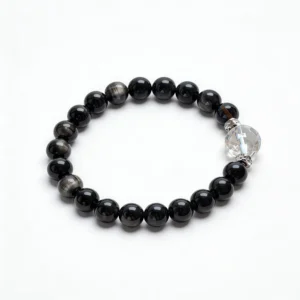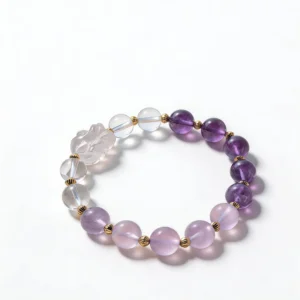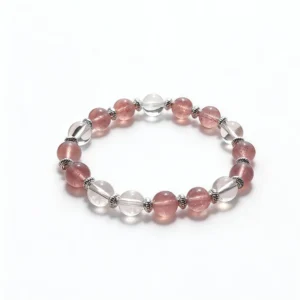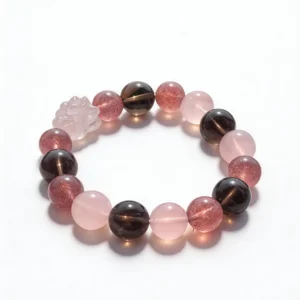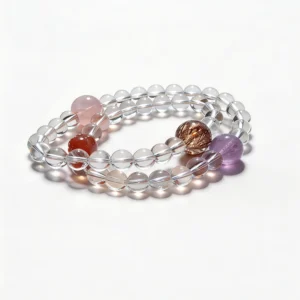


A crystal charm stack works best when every detail has a job. Stone beads provide color and pattern, while charms introduce shape, movement, and a focal point. The result can feel collected and personal, but only when the pieces sit comfortably together. This guide focuses on what you can actually inspect: bead scale, attachment hardware, spacing, movement, fit, and finish.
These checks are useful whether you are reviewing product photos, opening a new piece, or arranging jewelry you already own. They are not laboratory tests and cannot prove a stone’s identity from appearance alone. Clear material naming, close-up images, dimensions, and direct seller answers are more useful than broad promises.
Start With the Charm, Not the Stone List
Choose one visual anchor before adding more elements. A shaped charm, engraved disc, or distinctive bead can lead the composition. Starting with a focal point makes it easier to judge which colors and bead sizes support it rather than compete with it.
Look at the charm from the front, side, and back when photos allow. The side view shows how far it projects from the bracelet and how the connecting ring is positioned. The back can reveal edges, recesses, or attachment points that are hidden in a straight-on image. Product dimensions matter here: a charm that looks small in a cropped photo may be substantial beside an 8 mm or 10 mm bead.
Check the attachment point
The small ring or loop connecting a charm to the bracelet affects both movement and orientation. Look for a connection that appears closed and aligned. If a listing shows only one angle, ask how the charm is attached and whether it is fixed in place or designed to move. A moving charm needs enough clearance to turn without constantly catching between neighboring beads.
Compare Bead Scale and Stone Variation
Use stated bead measurements instead of estimating from an isolated close-up. Two millimeters can make a visible difference in a stack, especially when several bracelets sit side by side. Repeating one bead size creates a steady rhythm; mixing sizes can frame the charm, but it also changes the weight and profile of the group.
Natural stone commonly shows variation from bead to bead. Compare changes in color, translucency, banding, clouding, and surface texture across all available photos. Variation can add depth to a charm stack, but appearance alone is not enough to authenticate a material. Evaluate a seller’s specific material description and disclosure of material enhancements as separate information.
Normal-light images are particularly helpful. Strong saturation, heavy contrast, and reflective studio lighting can make it difficult to compare color across products. When building a stack online, save screenshots of the full bracelets at a similar scale. This creates a more realistic side-by-side view than comparing enlarged detail shots.
Coordinate Metal Findings Deliberately
Findings include the charm loop, spacer beads, end caps, clasp components, and other connecting hardware. They may occupy little space, but their color and finish repeat throughout a stack. Decide whether you want those details to match or provide controlled contrast.
- Matching finish: repeating one metal color keeps several charms visually connected.
- Mixed finish: use one recurring element, such as bead color or charm shape, so the stack still has a clear relationship.
- Surface condition: inspect close-ups for scratches, uneven plating, sharp-looking edges, and visible gaps at connecting rings.
- Spacer placement: confirm that decorative metal pieces do not crowd the charm or hide its outline.
Do not assume a metal type from color alone. If composition, plating, or care restrictions matter to you, rely on the product description or ask for clarification before purchase.
Test Movement, Weight, and Wrist Fit
A charm changes how a bracelet behaves. Its weight can rotate an elastic bracelet, tap against a neighboring piece, or settle under the wrist while typing. That does not automatically indicate a problem, but it should inform how many moving pieces you combine.
Begin with two bracelets and add one at a time. Leave enough space for each piece to move without forcing charms between beads or under a watch case. If the stack feels dense, remove one moving element rather than tightening the entire group. A slim plain-bead bracelet can create separation without adding another focal point.
Check fit independently for every bracelet. Wrist circumference is only the starting measurement; bead diameter and the number of adjacent pieces affect how the stack feels. A product page should state useful sizing information, and a custom design should make the intended fit clear. The QZZEN bracelet builder can be used to compare bead choices and review a design before checkout.
Use a Five-View Photo Check
Before deciding on a charm piece, look for five practical views. Together they answer more questions than one polished hero image.
- Full bracelet: shows the overall spacing and the charm’s proportion.
- Charm front: shows the primary shape, color, and surface detail.
- Charm side or back: shows projection, attachment, and edge finish.
- Bead close-up: shows variation across several beads rather than one selected example.
- On-wrist view: gives useful scale when paired with actual measurements.
If an important view is missing, regard that as a question to resolve rather than filling the gap with an assumption. For a concrete comparison, review the image angles and listed details on the Lavender Amethyst Fox Charm Bracelet, then compare its bead and charm proportions with other pieces you are considering.
Keep the Stack Easy to Wear and Store
Put bracelets on one at a time instead of stretching several pieces over the hand together. After wear, inspect the charm loop, neighboring beads, and elastic or clasp area for visible changes. Follow the care instructions supplied with the piece, and avoid assuming that every stone or metal finish tolerates the same cleaning method.
Store charm bracelets so projecting pieces do not press into adjacent beads or tangle with other chains. Separate compartments or soft pouches make the focal elements easier to see and reduce contact between metal edges and polished surfaces. Before gifting, check that the selected size, material name, charm orientation, and care information are easy for the recipient to understand.
Build Around One Clear Detail
A strong charm stack does not need the most components. It needs a clear focal point, readable proportions, compatible movement, and enough spacing to stay comfortable. Start with one charm, verify the material and dimensions you can document, then add only the pieces that improve the composition.
Browse crystal bracelets, explore the QZZEN shop, or begin a custom bracelet design with bead scale, fit, and the focal detail already in mind.